Kriti
Alam

PhD Candidate in theoretical and computational chemistry at the University of North Texas. I build machine-learned force fields for condensed-phase systems, and the infrastructure that trains them.

Position
Ph.D. Candidate, Chemistry
Group
Ko Research Group, University of North Texas
Focus
MLFFs · Ab initio MD · DFT · Kubernetes
Location
Denton, Texas
Email
KritiAlam@my.unt.edu
Kriti Alam
Periodic cell · 12 particles

About

I work on making quantum-accurate simulation cheap enough to be useful at the length and time scales where chemistry actually happens.

I am in Prof. Hsin-Yu Ko’s group, the Ko Research Group at UNT, developing machine-learned force fields for polymer structure prediction, computing infrared spectra in situ from ab initio trajectories, and using localized orbitals to find reaction pathways in condensed-phase systems. A good part of my time goes to the unglamorous half of that problem: generating trustworthy training data, and building pipelines that run the same way twice.

Before this I worked with Prof. Omar Valsson on machine-learned collective variables for driving polymorphic transitions in molecular crystals, and before that on lipid bilayer dynamics under salt at IIT Jodhpur. Both taught me not to trust a simulation until I have watched it converge from two directions.

News

  • Apr 2026

    Awarded Second Prize — UNT Chemistry 3rd Year Seminar

    “Machine-Learning Explorations of Condensed-Phase Molecular Structures: From Molecular Crystals to Amorphous Polymers”

  • Apr 2026

    Oral presentation — ACS DFW Meetings in Miniature

    Texas Wesleyan University

  • Oct 2025

    Began advising under Prof. Hsin-Yu Ko

    Joined the Ko Research Group at UNT

  • Aug 2025

    Oral presentation — ACS Fall Meeting

    Washington, D.C.

  • Apr 2025

    Oral presentation — ACS DFW Meetings in Miniature

    East Texas A&M University

  • Feb 2025

    Oral presentation — Texas Computational Chemistry Symposium

    Texas Woman’s University

  • Fall 2023

    Awarded Best Teaching Assistant

    Chemistry Resource Center, University of North Texas

Research

  • Machine-learned force fields for polymer structure prediction

    Active-learning loops that decide for themselves which configurations are worth a DFT calculation, applied to polymer systems where the interesting physics lives in weak, many-body interactions.

    DeePMD-kit · DP-GEN · LAMMPS

  • In-situ vibrational spectroscopy and reaction discovery

    Infrared spectra recovered from dipole autocorrelation along ab initio trajectories, and localized orbitals used to trace bond making and breaking in condensed-phase reactions rather than guessing at a mechanism in advance.

    Quantum ESPRESSO · Wannier localization · AIMD

  • Simulation infrastructure that survives contact with reality

    Containerized, GPU-accelerated DFT and MD dispatched onto Kubernetes rather than a batch scheduler — with the isolation, reproducibility, and cleanup guarantees a multi-week active-learning campaign needs.

    Kubernetes · Docker · Apptainer · CUDA

  • Collective variables for molecular crystal polymorphism

    Earlier work with Prof. Omar Valsson: learning collective variables from data to drive polymorphic transitions in molecular crystals, and sampling the free-energy landscapes between forms.

    PLUMED · Metadynamics · SOAP descriptors

  • Simulation of microelectronic surfaces

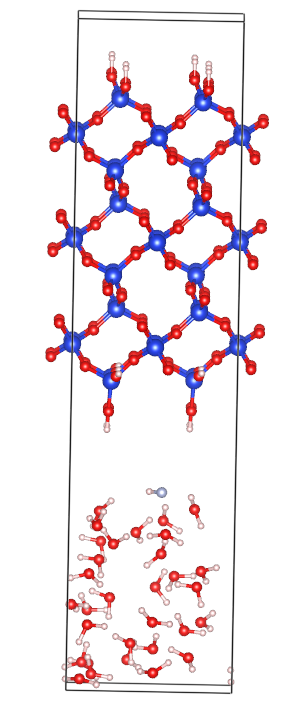
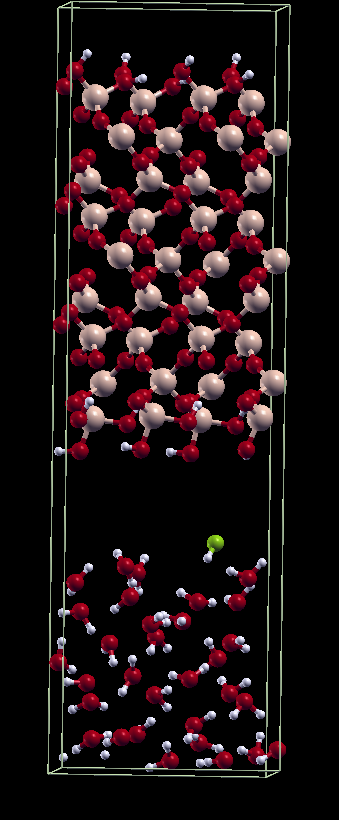
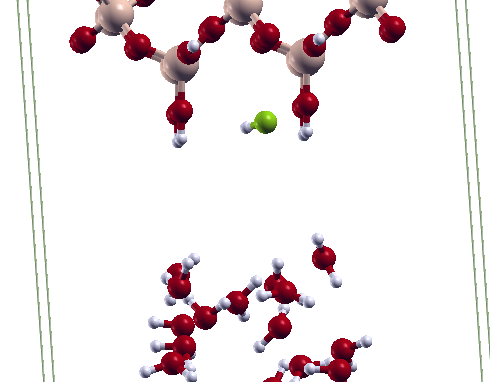
    An atomistic view of how hydrofluoric acid etches SiO2, aimed at the mechanistic questions the microelectronics industry actually cares about. Ab initio molecular dynamics follows the reaction pathway at the surface as it unfolds, rather than assuming a mechanism in advance, and orbital localization methods are used to see which bonds are forming and breaking and why — turning the trajectory into a bond-by-bond account of the etch chemistry.

Publications

  • 2026
    Preprint

    Bottom-Up Prediction of Amorphous Poly(1,3-dioxolane) using Ab Initio Reactive Machine-Learning Force Fields

    Yizhi Song, Bharatha K. Gunawardana, Kriti Alam, Teresa Shah, Deepa Ranabhat, Hsin-Yu Ko · arXiv:2610.09388

    arXivPDFDOI

Full and up-to-date list on Google Scholar.

Skills

Electronic structure & simulation

  • Quantum ESPRESSO
  • DFT
  • AIMD
  • Wannier localization
  • LAMMPS

Machine learning for chemistry

  • DeePMD-kit
  • DP-GEN
  • Active learning
  • PLUMED
  • Metadynamics
  • SOAP descriptors

Infrastructure & compute

  • Kubernetes
  • Docker
  • Apptainer
  • CUDA
  • Slurm / HPC scheduling

Languages & tooling

  • Python
  • Bash
  • Git
  • LaTeX

Development

  • Project

    Double-Well Lab — Overdamped Langevin Dynamics in the Browser

    scichemcode.github.io/Overdamped_LD

    An interactive lab for thermally activated barrier crossing. A Brownian particle in a double-well potential is simulated live by my tested Python package, which runs in the browser through Pyodide. Sliders for barrier height, temperature, friction, well position and time step rerun the simulation as you drag, and the hop statistics are compared against the exact first-passage time and Kramers’ rate.

    Open full page ↗Code ↗

  • Project

    Android Phone as a Quantum ESPRESSO Job Server

    scichemcode.github.io/phone_server_qe

    Turns a spare Android phone into a remote DFT job server — Termux, a Flask/Redis job queue, and a Tailscale mesh let a laptop submit and monitor Quantum ESPRESSO calculations from anywhere.

Claude-based Software Troubleshooting

Scientific visualization on WSL2

Fixing a disappearing mouse pointer in OVITO on WSL2

Problem: On Windows with WSL2, launching the OVITO GUI from a WSL terminal opened the window fine, but the mouse pointer kept disappearing inside it.

Diagnosis

  • XDG_SESSION_TYPE was empty while DISPLAY=:0 and WAYLAND_DISPLAY=wayland-0 were set, which pointed to WSLg. uname -r confirmed it (...microsoft-standard-WSL2).
  • WSL (2.6.3) and WSLg (1.0.71) were already up to date.
  • The problem is in WSLg’s cursor handling (its RDP-based display layer), not in OVITO itself.

What didn’t help

  • QT_QPA_PLATFORM=xcb (OVITO’s bundled Qt already uses xcb; it has no Wayland plugin)
  • Setting a cursor theme (XCURSOR_THEME=Adwaita XCURSOR_SIZE=24)
  • Forcing software OpenGL (LIBGL_ALWAYS_SOFTWARE=1)

Fix: bypass WSLg with VcXsrv

  1. Install VcXsrv on Windows (winget install marha.VcXsrv).
  2. Start XLaunch with Multiple windows, Start no client, Disable access control checked, and Native opengl unchecked.
  3. Allow WSL to reach the X server. In NAT networking mode the WSL network counts as Public, so add a firewall rule restricted to the WSL subnet (admin Command Prompt):
    netsh advfirewall firewall add rule name="VcXsrv WSL" dir=in action=allow program="C:\Program Files\VcXsrv\vcxsrv.exe" enable=yes profile=any remoteip=192.168.128.0/20
    (Check your mode with wslinfo --networking-mode; in mirrored mode use DISPLAY=127.0.0.1:0 instead.)
  4. Add a shell function to ~/.bashrc so only OVITO uses VcXsrv and other apps stay on WSLg:
    ovito-x() { DISPLAY=$(ip route | awk '/default/ {print $3}'):0 WAYLAND_DISPLAY= LIBGL_ALWAYS_SOFTWARE=1 ovito "$@"; }
  5. Start VcXsrv, then run ovito-x. The pointer now behaves normally.
Prompts I used (with Claude)
  1. “mouse pointer not showing sometimes on ovito when using from terminal”
  2. “this shows blank” (output of echo $XDG_SESSION_TYPE)
  3. Output of echo "DISPLAY=$DISPLAY WAYLAND=$WAYLAND_DISPLAY"
  4. Error from QT_QPA_PLATFORM=wayland ovito
  5. “this does not show the cursor” / “not working” (xcb and cursor-theme attempts)
  6. Output of uname -r
  7. “lets stick to fixing the WSL”
  8. “is not showing the mouse pointer” (software OpenGL attempt)
  9. OVITO’s terminal output (portal and Vulkan warnings)
  10. Output of wsl.exe --version
  11. “its stuck without opening the ovito window” (first VcXsrv attempt)
  12. “its back but no mouse pointer” (after reverting DISPLAY)
  13. “nat” (output of wslinfo --networking-mode)
  14. Firewall rule error, then the netsh rule returning Ok.
  15. “works!!”

Research Experience

  • 2021–2023

    M.Sc. Thesis: Bilayer Phase Transition in the Presence of Salts: A Molecular Dynamics Study

    Indian Institute of Technology Jodhpur · Advisor: Prof. Ananya Debnath

    Download (PPTX)

Education

  • 2023–

    Ph.D., Chemistry

    University of North Texas · Advisor: Prof. Hsin-Yu Ko (since Oct 2025), previously Prof. Omar Valsson

  • 2021–2023

    M.Sc., Chemistry

    Indian Institute of Technology Jodhpur · Advisor: Prof. Ananya Debnath

    Understanding lipid dynamics in model lipid bilayers under the influence of salts using molecular dynamics simulations

  • 2017–2020

    B.Sc., Chemistry (Hons.)

    New Alipore College, University of Calcutta

Talks & schools

  • Apr 2026

    Oral presentation — ACS DFW Meetings in Miniature

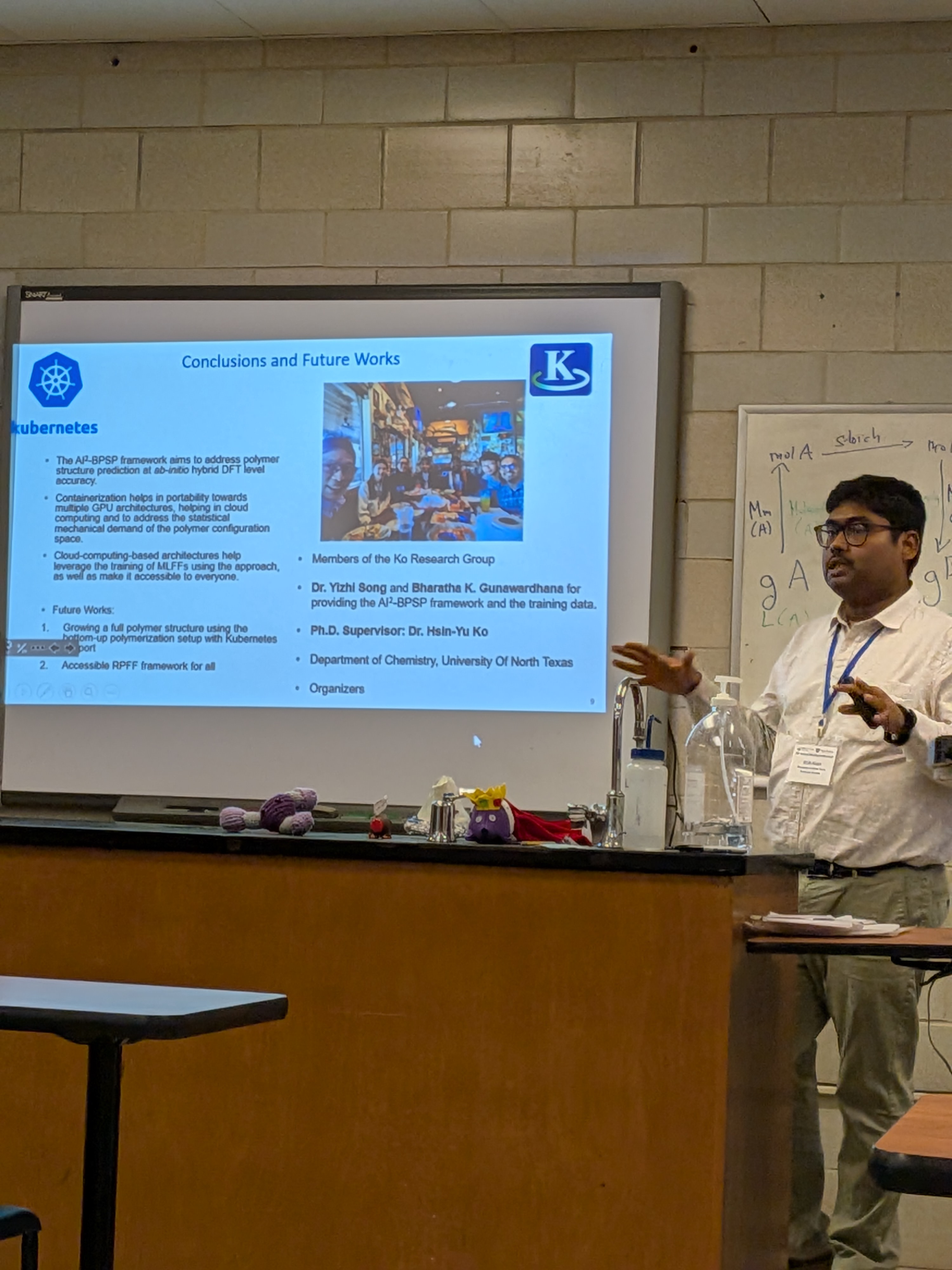
    “Bringing AI-Accelerated Ab Initio Bottom-Up Polymer Structure Prediction Framework to The Cloud”

    Texas Wesleyan University

  • Aug 2025

    Oral presentation — ACS Fall Meeting

    Washington, D.C.

  • Apr 2025

    Oral presentation — ACS DFW Meetings in Miniature

    East Texas A&M University

  • Feb 2025

    Oral presentation — Texas Computational Chemistry Symposium

    “Classifying Molecular Crystal Polymorphs using SOAP-PCA”

    Texas Woman’s University

  • School

    i-COMSE 7th Molecular Dynamics Summer School

    Boise State University · Python for MD, LAMMPS, HPC

  • School

    RESOLV Summer School on Solvation Science

    Ruhr University Bochum, Germany

Training/Education

  • Video

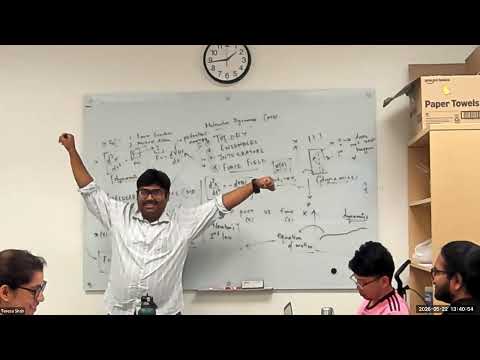
    Molecular Dynamics: Basics

    Thumbnail for the Molecular Dynamics: Basics video

    YouTube · Watch

    An introductory walkthrough of molecular dynamics fundamentals.

Teaching

  • 2023–

    Chemistry Resource Center

    General chemistry concept clarification, one on one and in small groups.

    Best Teaching Assistant, Fall 2023
  • 2024, 2025

    Teaching assistant — Physical Chemistry II

    Spring 2024 with Dr. Omar Valsson; Spring 2025 with Dr. Hsin-Yu Ko.

  • 2024–2025

    Laboratory instructor — Physical and Organic Chemistry

    Fall 2024 and Spring 2025.

Contact

I am happy to chat if you have scientific ideas and would love to have discussions, as well as find probable opportunities for collaboration.

Group
ko-research.org
Email
KritiAlam@my.unt.edu
GitHub
scichemcode
LinkedIn
kritialam
CV
cv.pdf